
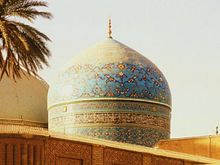
 Abd al-Qadir Gilani (Persian: عبدالقادر گیلانی, Arabic: عبدالقادر الجيلاني, Turkish: Abdülkâdir Geylânî, Kurdish: Evdilqadirê Geylanî, Central Kurdish: عهبدوالقادری گهیلانی[9], born 29 Shaban 470 AH in the town of Na'if), district of Gilan-e Gharb, Gilan, Iran and died Monday, February 14, 1166 (11 Rabi' al-thani 561 AH), in Baghdad,[10] (1077–1166 CE), was a Persian[11] Hanbali Sunni[4][5] jurist and sufi based in Baghdad. The Qadiriyya is the tariqa (Sufi order) founded by him and takes its name from him.
Contents
Family
Al-Gilani was born around 1077 in Persia.[nb 1][12] Al-Gilani's father, Abu Salih Musa al-Hasani, was a descendant of Hasan ibn Ali, (Imam Hasan). Hasan was the eldest son of Ali and Fatimah. Ali was Muhammad's son-in-law and also cousin and Fatima was Muhammad's daughter. Al-Gilani's mother was the daughter of Abdullah Sawmai, a descendant of Husayn ibn Ali, the younger son of Ali and Fatima. Thus, Al-Gilani was both a Hasani and Hussaini Sayyid.Name
Gilani is granted the title Sayyid to indicate his claimed descent from Muhammad.[13] The name Muhiyudin describes him as a "reviver of religion".[14] Gilan (Arabic al-Jilani) refers to his place of birth, Gilan.[15][16] However, Gilani also carried the epithet Baghdadi.[17][18][19] referring to his residence and burial in Baghdad. He is also called al-Hasani wa'l-Husayni, which indicates a claim to lineal descent from both Hasan ibn Ali and Husayn ibn Ali, the sons of Ali and grandsons of Muhammad.[20][21]Paternal heritage
Gilani's father claimed Sayyed lineage.[22][23] He was respected as a saint by the people of his day, and was known as Jangi Dost "who loves God", thus "Jangidost" was his sobriquet.[24][25][26]Education
Gilani spent his early life in Na'if, the town of his birth. In 1095, at the age of eighteen years, he went to Baghdad. There, he pursued the study of Hanbali law [27] under Abu Saeed Mubarak Makhzoomi and ibn Aqil.[28] He was given lessons on Hadith by Abu Muhammad Ja'far al-Sarraj.[28] His Sufi spiritual instructor was Abu'l-Khair Hammad ibn Muslim al-Dabbas.[29] (A detailed description of his various teachers and subjects are included below). After completing his education, Gilani left Baghdad. He spent twenty-five years as a reclusive wanderer in the desert regions of Iraq.[30]Education in Baghdad
At the age of 18, Gilani went to Baghdad to study the Hanbali school of fiqh.| Subject | Shaykh (Teacher) |
|---|---|
| Fiqh (Islamic Jurisprudence) | Ibn Aqil |
| Fiqh (Islamic Jurisprudence) | Abu Al Hasan Muhammad ibn Qazi Abu Yali |
| Fiqh (Islamic Jurisprudence) | Abu Al Khatab Mahfuz Hanbali |
| Fiqh (Islamic Jurisprudence) | Muhammad ibn Al Husnayn |
| Fiqh (Islamic Jurisprudence) | Abu Saeed Mubarak Makhzoomi |
| Tasawwuf (Sufism) | Abu Saeed Mubarak Makhzoomi
Abu'l-Khair Hammad ibn Muslim al-Dabbas Abu Zakariay ibn Yahya ibn Ali Al Tabrezi |
| Hadith | Abu Bakr ibn Muzaffar |
| Hadith | Muhammad Ibn Al Hasan Baqalai Abu Sayeed
Muhammad ibn Abdul Kareem |
| Hadith | Abu Al Ghanaem Muhammad Ibn Muhammad Ali Ibn Maymoon Al Farsi |
| Hadith | Abu Bakr Ahmad Ibn Al Muzaffar |
| Hadith | Abu Jafer Ibn Ahmad Ibn Al Hussain Al Qari |
| Hadith | Abu Al Qasim Ali Ibn Muhammad Ibn Banaan Al Karkhi |
| Hadith | Abu Talib Abdul Qadri Ibn Muhammad Yusuf |
| Hadith | Abdul Rahman Ibn Ahmad Abu Al Barkat Hibtaallah Ibn Al Mubarak |
| Hadith | Abu Al Nasr Ibn Il Mukhtar |
| Hadith | Abu Nasr Muhammad |
| Hadith | Abu Ghalib Ahmad |
| Hadith | Abu Abdullah Aulad Ali Al Bana |
| Hadith | Abu Al Hasan Al Mubarak Ibn Al Teyvari |
| Hadith | Abu Mansur Abdurahman Al Taqrar |


No comments:
Post a Comment